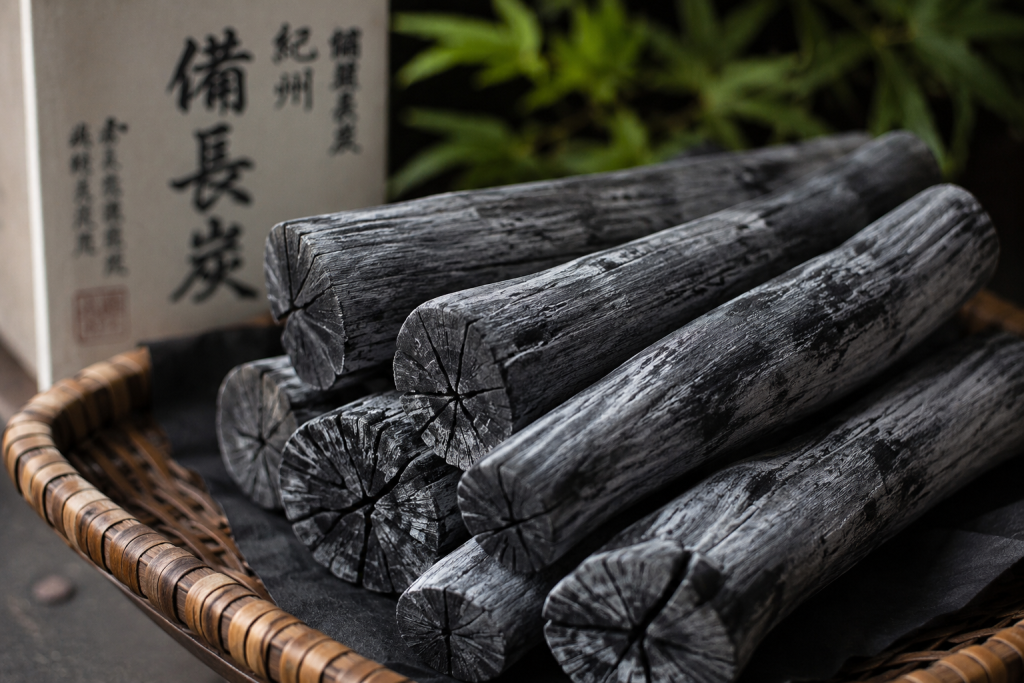
Among Japan’s many traditional crafts, few are as simple in appearance yet as remarkable in quality as Kishu Binchotan, Japan’s finest white charcoal. Often called the “Black Diamond of Japan,” Kishu Binchotan has been treasured for centuries for its exceptional purity, durability, and versatility. While it is best known as the preferred charcoal for high-end Japanese cuisine, it also represents the Japanese philosophy of craftsmanship, sustainability, and respect for nature.
Kishu Binchotan originates from Wakayama Prefecture, formerly known as Kishu, where skilled charcoal makers have refined their techniques for hundreds of years. The charcoal is produced primarily from ubame oak, a dense hardwood that grows slowly along Japan’s southern coast. Unlike ordinary charcoal, Binchotan is fired at extremely high temperatures before being cooled with a mixture of ash and sand, giving it its distinctive pale-gray surface and exceptional hardness. When two pieces are struck together, they produce a clear metallic sound—a sign of their remarkable density and quality.
The most famous use of Kishu Binchotan is in Japanese grilling. Top restaurants use it to prepare yakitori, eel, seafood, and premium wagyu beef because it burns steadily for many hours while producing very little smoke. More importantly, it emits intense infrared heat, allowing ingredients to cook evenly without overpowering their natural flavors. This is one reason why many of Japan’s finest chefs continue to choose Binchotan over modern fuels.
Beyond cooking, Binchotan has become popular as a natural lifestyle product. Its porous structure allows it to absorb odors and moisture, making it useful in closets, shoe cabinets, refrigerators, and living spaces. Some people also place specially prepared Binchotan in water pitchers to improve the taste of drinking water by releasing naturally occurring minerals. While some traditional claims continue to be explored scientifically, its deodorizing and moisture-regulating properties have made it a favorite among people seeking environmentally friendly alternatives.
For visitors to Tokyo, one of the best places to discover the world of Binchotan is GINZA TANAGOKORO, located in the heart of Ginza. Opened in 1999, it is recognized as the world’s first specialty shop dedicated entirely to Kishu Binchotan. Rather than selling charcoal only for cooking, the store showcases beautifully crafted lifestyle products, decorative objects, kitchen accessories, and elegant gifts that highlight the natural beauty of this traditional material. The building also includes a tea room and a bar, allowing visitors to experience Japanese hospitality through the unique atmosphere created by Binchotan.
What makes the shop especially interesting is its commitment to sustainability. The company works closely with charcoal producers in Wakayama and supports long-term forest restoration projects, emphasizing responsible woodland management and the preservation of traditional craftsmanship. Even small pieces of charcoal that might otherwise become waste are transformed into artistic objects and accessories, reflecting Japan’s philosophy of using natural resources with care and respect.
Kishu Binchotan represents more than a cooking tool or household item. It tells a story about the relationship between people and forests, about generations of artisans who have perfected their techniques, and about a culture that values quality over quantity. In a world increasingly focused on sustainability, its enduring appeal feels more relevant than ever.
Whether you enjoy Japanese cuisine, appreciate traditional craftsmanship, or simply wish to bring home a meaningful souvenir, Kishu Binchotan offers a unique connection to Japan’s cultural heritage. Sometimes, the simplest objects carry the deepest stories—and a single piece of charcoal can reveal centuries of wisdom, patience, and respect for nature.