Among the many expressions that shape Japanese culture, few are as widely loved as ichigo ichie (一期一会). It is often translated as “one time, one meeting” or “once in a lifetime encounter.” Yet these simple translations only hint at its deeper meaning.
For many Japanese people, ichigo ichie is not merely a proverb. It is a way of looking at relationships, daily life, and the passing of time.
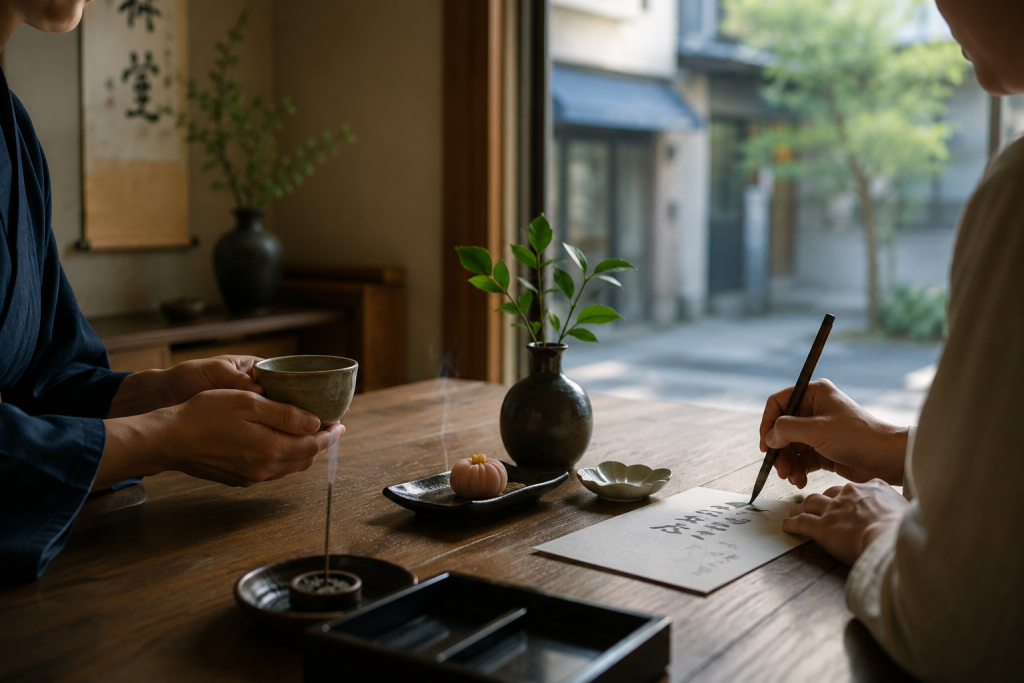
The phrase is closely associated with the Japanese tea ceremony, or sadō (the Way of Tea). During the sixteenth century, tea masters taught that every gathering should be treated as unique, even if the same people met again the following day. The season would be different. The weather would have changed. The flowers in the tea room would not be exactly the same. The participants themselves would have grown older, even if only by a single day.
No meeting can ever be perfectly repeated.
This idea encouraged both host and guest to treasure the present moment with sincerity and gratitude.
Over time, ichigo ichie expanded beyond the tea room and became part of everyday Japanese thinking.
Today, the phrase appears in schools, businesses, sports teams, restaurants, books, and ordinary conversations. Parents teach it to children. Teachers use it to encourage students to value friendships. Companies may remind employees that every customer interaction is unique and deserves genuine attention.
The expression reflects an important aspect of Japanese culture: an awareness that life is constantly changing.
This understanding has deep roots in Japanese philosophy and aesthetics. Influenced by Buddhism, Japanese culture often emphasizes the impermanence of all things. Cherry blossoms bloom brilliantly but fall within days. The changing seasons remind people that beauty is temporary. Even familiar places gradually change with time.
Because nothing remains exactly the same, every encounter becomes precious.
This perspective also influences the way many Japanese people communicate. Conversations are often approached with attentiveness rather than haste. Hospitality is valued not simply as good service but as a sincere effort to create a meaningful experience for another person.
When welcoming guests, serving tea, preparing a meal, or offering assistance, many people try to act as though this particular meeting may never happen again.
Such an attitude transforms ordinary moments.
A brief conversation with a stranger.
A meal shared with friends.
A quiet walk through a garden.
A chance meeting during a journey.
These moments may appear ordinary, yet ichigo ichie encourages people to recognize that they are, in fact, unrepeatable.
Interestingly, the phrase has become increasingly relevant in the modern world. Digital technology allows people to communicate instantly across continents, yet interactions often become faster and more disposable. Messages disappear in endless timelines, and conversations are quickly replaced by new notifications.
Ichigo ichie offers a different perspective.
Rather than asking how many connections we have, it asks how deeply we experience each one.
Rather than rushing toward the next moment, it reminds us to fully appreciate the present one.
This may explain why the phrase continues to resonate across generations in Japan. It is not about nostalgia or tradition alone. It is about living with greater awareness.
Whether sharing tea with a close friend, meeting someone for the first time, or simply watching the evening sky, ichigo ichie reminds us that this exact moment has never existed before—and will never exist again.
In a rapidly changing world, that simple idea remains one of Japan’s most enduring gifts to everyday life.