Japan is not found only within the islands of the Japanese archipelago. Across the world, Japanese culture has taken root in unexpected places through migration, business, food, religion, festivals, and everyday community life. Some of these places are called Japantowns, while others are agricultural colonies, business districts, or neighborhoods shaped by generations of Japanese descendants. Together, they show how Japan has traveled, adapted, and survived far beyond its borders.
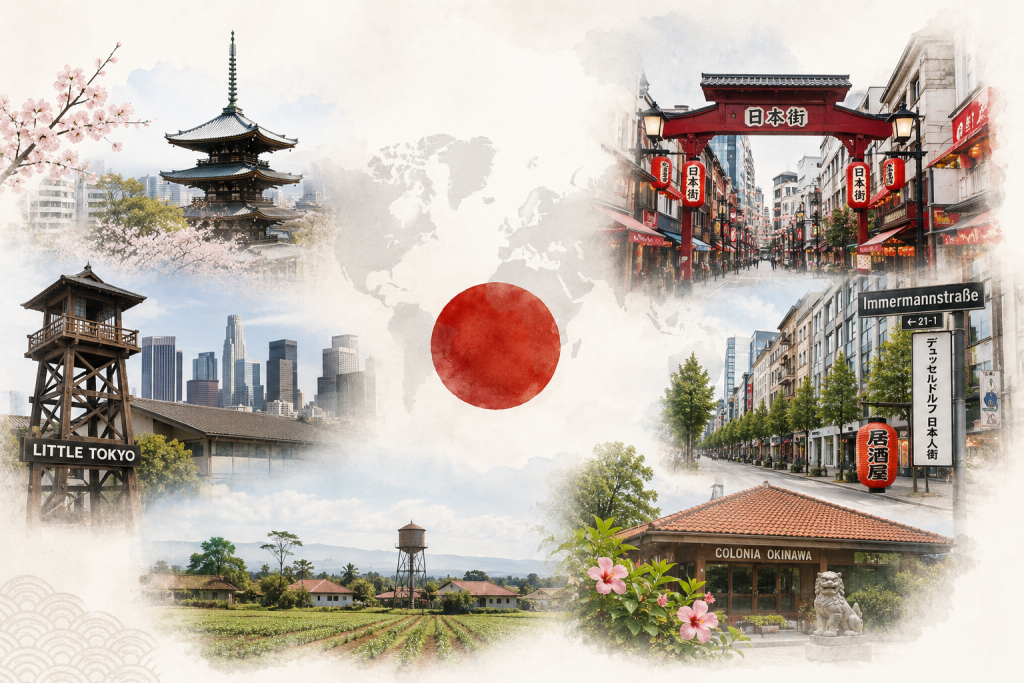
One of the most famous examples is Liberdade in São Paulo, Brazil. Brazil has the largest Japanese-descended population outside Japan, and Liberdade remains a powerful symbol of that history. Its lantern-style streetlights, Japanese restaurants, markets, festivals, and cultural associations make it one of the world’s most important Japanese districts. Today, it is also a broader Asian neighborhood, but its Japanese roots remain central to its identity.
In the United States, Little Tokyo in Los Angeles is one of the oldest and best-known Japanese communities. It reflects the history of Japanese immigration, wartime hardship, postwar rebuilding, and contemporary cultural revival. Visitors can find Japanese food, Buddhist temples, cultural museums, bookstores, and festivals that connect past and present.
Another important American example is Japantown in San Francisco. Unlike many historic ethnic neighborhoods that disappeared through redevelopment, San Francisco’s Japantown still maintains a visible cultural presence. Its malls, restaurants, cultural centers, and annual events continue to serve both local Japanese Americans and visitors interested in Japanese culture.
In Europe, Düsseldorf in Germany offers a different kind of Japanese presence. Rather than being formed mainly by early immigrant settlement, Düsseldorf’s Japanese community grew through business connections. The city is home to many Japanese companies, restaurants, supermarkets, schools, and cultural institutions. The area around Immermannstraße is often called “Little Tokyo on the Rhine,” and it shows how modern global business can create a living Japanese district overseas.
In South America, Colonia Yguazú in Paraguay represents a more rural version of Japan abroad. Established by Japanese immigrants, it developed as an agricultural settlement. Unlike urban Japantowns filled with restaurants and shops, this community is connected to farming, land, and the long-term effort of migrants building a new life in a distant country.
Another remarkable case is Colonia Okinawa in Bolivia. Created by immigrants from Okinawa after World War II, it is not simply a Japanese village but a distinctly Okinawan community overseas. Its history reflects displacement, resilience, and the preservation of regional identity far from home.
These six places remind us that “Japan” is not a fixed idea. Outside Japan, Japanese culture often changes. It mixes with local languages, ingredients, climates, architecture, and ways of life. Sushi may become Brazilian-Japanese. A festival in Los Angeles may express Japanese American memory. A village in Bolivia may preserve Okinawan traditions in a South American landscape.
For travelers, these communities offer more than familiar Japanese food. They reveal the global story of migration, adaptation, and belonging. To visit them is to see how culture moves across oceans and generations.
Japan outside Japan is never exactly the same as Japan itself. That is precisely what makes it fascinating.