Japan has long had a special relationship with plants. From carefully shaped bonsai trees to moss gardens and seasonal flower arrangements, nature has always played an important role in Japanese aesthetics. Today, that tradition continues in a modern form: the growing popularity of houseplants.
For many people in Japan, houseplants are not simply decorations. They bring calm, softness, and a sense of nature into compact urban homes. In cities like Tokyo, where apartments can be small and outdoor gardens are rare, a single plant can transform a room. It creates a small personal landscape within everyday life.
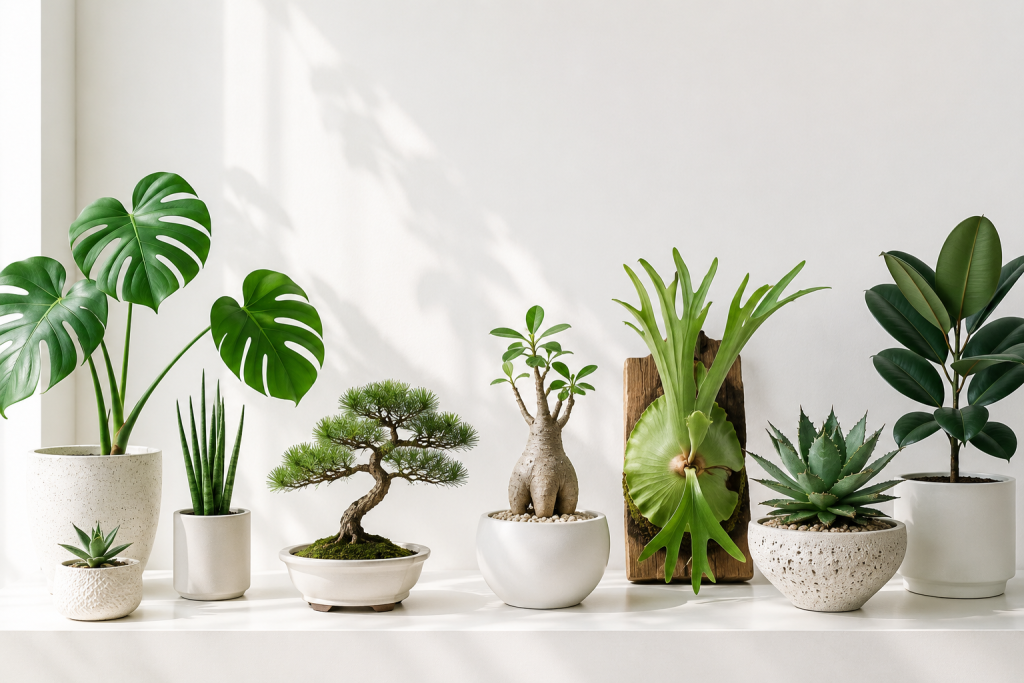
Some of the most popular houseplants in Japan are familiar around the world. Monstera is loved for its large tropical leaves and bold shape. Ficus umbellata, with its soft heart-shaped leaves, is often seen in stylish cafés and natural interiors. Pachira is popular because it is easy to care for and is sometimes associated with good fortune. Sansevieria, with its upright leaves, fits well with minimalist Japanese interiors.
However, Japan’s plant culture becomes especially interesting when we look at more unusual plants. In recent years, collectors have become fascinated by agave, staghorn ferns, and caudex plants. These are not always conventionally beautiful. Some have sharp sculptural forms, strange swollen trunks, or wild, asymmetrical leaves. Their appeal lies in individuality.
This taste is not entirely new. Bonsai has always valued character, age, imperfection, and the unique shape of each living plant. Modern rare plant collecting follows a similar logic. An agave with a powerful silhouette or a caudex plant with a strange body can be appreciated almost like a small sculpture. It is a living object, but also a work of design.
Staghorn ferns, known in Japanese as bikakushida or koumoriran, are particularly popular among design-conscious plant lovers. Instead of being placed in ordinary pots, they are often mounted on wooden boards and displayed on walls. This makes them feel closer to art objects than typical houseplants.
Agave and caudex plants have also developed strong collector communities. Their slow growth and unusual forms make them attractive to people who enjoy observing small changes over time. In this sense, they reflect a very Japanese appreciation for patience, detail, and long-term care.
For visitors to Japan, plant shops can be surprisingly rewarding places to explore. They often combine gardening, interior design, ceramics, and lifestyle culture. A small plant in a handmade pot can reveal much about contemporary Japanese taste: natural, restrained, thoughtful, and quietly expressive.
Houseplants in Japan show how traditional aesthetics continue to evolve. The same culture that created bonsai now embraces tropical leaves, desert plants, and sculptural roots. What connects them all is the joy of bringing nature close, even in the middle of a busy city.
In Japan, a plant is rarely just a plant. It is a companion, an object of care, and sometimes a small living artwork.