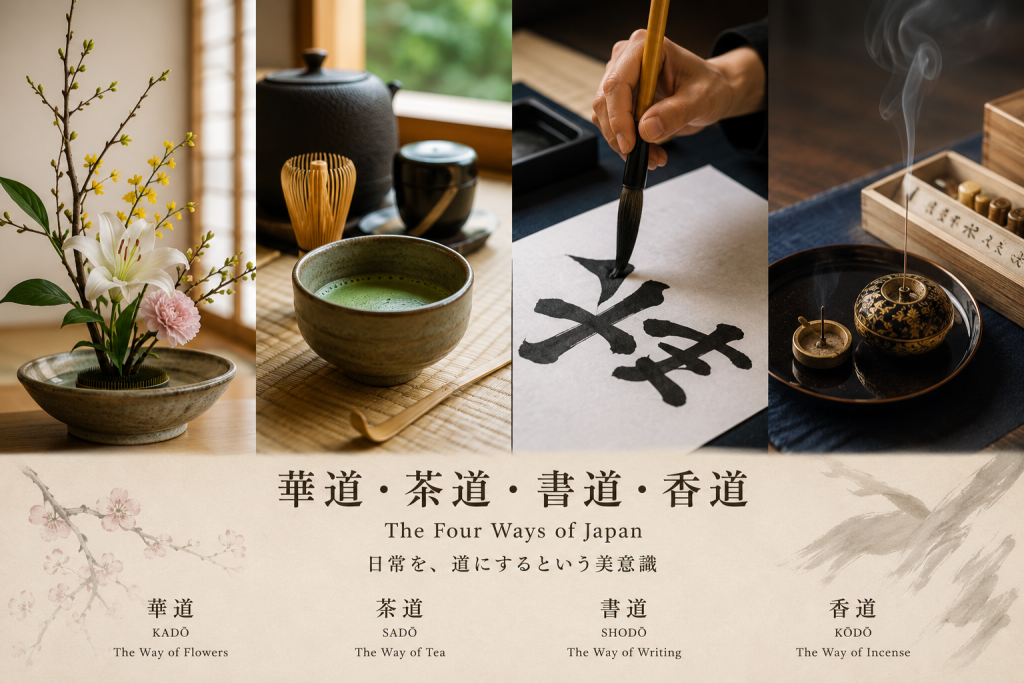
Japan has many traditional arts, but four stand out for sharing a single idea: kadō (the way of flowers), sadō (the way of tea), shodō (the way of writing), and kōdō (the way of incense).
At first, the activities themselves seem ordinary. People arrange flowers, drink tea, write words, and enjoy fragrance all over the world. In Japan, however, these practices developed into a dō—a “way” or lifelong path.
Why?
Kadō, often known internationally as ikebana, begins with flowers but is not simply flower decoration. Western-style arrangements often emphasize abundance, color, and symmetry. Kadō may give equal importance to an empty space, a bent branch, or a single flower. The practitioner does not simply make nature more beautiful. Instead, the arrangement creates a relationship between nature, space, and the person observing it.
Sadō, the way of tea, transforms an everyday drink into a carefully structured encounter. Every movement matters: preparing the utensils, cleaning them, making the tea, serving the guest, and appreciating the bowl. The purpose is not efficiency. A cup of tea that could be prepared in minutes becomes an opportunity to pay complete attention to one moment.
Shodō, the way of writing, reveals a similar philosophy. Japanese calligraphy is not only about producing beautiful characters. The movement of the body, the pressure of the brush, the amount of ink, and even the empty paper around the characters all become part of the work. A brushstroke cannot easily be erased or corrected. The result records a particular movement at a particular moment.
Perhaps the least internationally known of the four is kōdō, the way of incense. Its most distinctive idea is that people do not simply “smell” incense. Traditionally, they are said to “listen” to fragrance. This unusual expression suggests a deeper form of attention. Different aromatic woods are experienced, remembered, compared, and sometimes identified through games.
These four traditions share several characteristics.
First, they slow down ordinary actions. Drinking, writing, arranging, and smelling are usually performed without much thought. The dō transforms them into practices of attention.
Second, they value repetition. A practitioner may repeat the same movements for years, yet the goal is not simply technical perfection. Through repetition, small differences become visible.
Third, they value what cannot easily be measured. There is no simple score for the perfect flower arrangement, brushstroke, bowl of tea, or fragrance. Knowledge develops through experience.
This may explain why these traditions continue to attract people in modern Japan. Contemporary life is fast, digital, and filled with constant information. The four ways offer the opposite: physical materials, repeated gestures, silence, and concentration.
They also reveal something important about Japanese culture. An ordinary activity does not need to remain ordinary. If it is practiced with enough attention, discipline, and sensitivity, it can become a way of seeing the world.
A flower, a bowl of tea, a brush, or a piece of fragrant wood is only the beginning.
The real subject is attention itself.