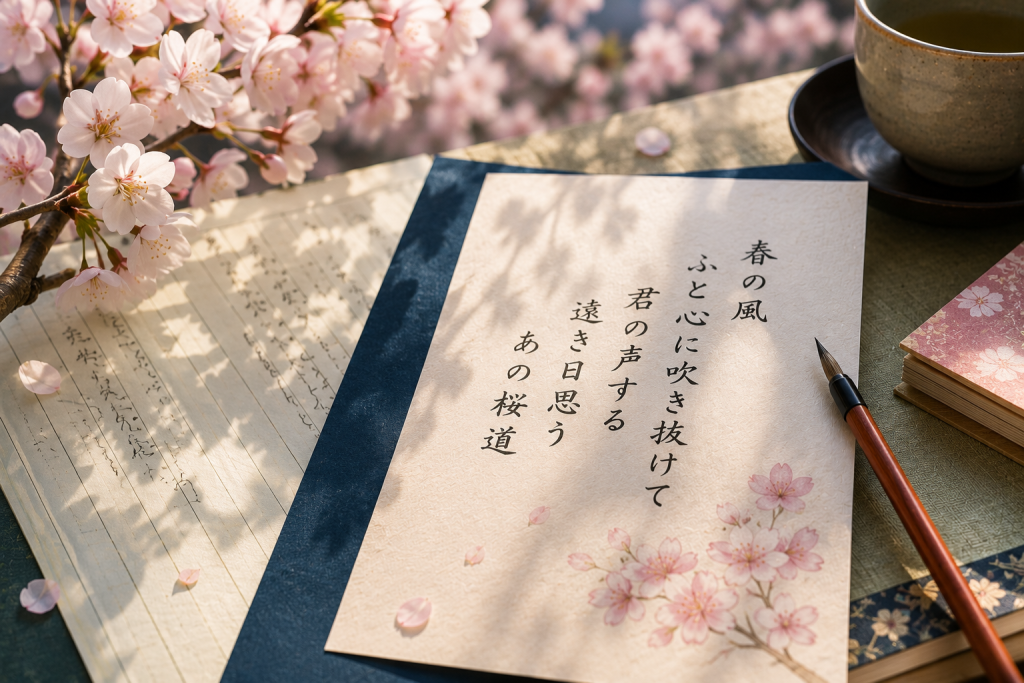
Tanka is one of Japan’s oldest forms of poetry.
While haiku is widely known around the world, tanka has an even longer history and offers a different way of capturing human experience. Traditionally written in a 5–7–5–7–7 rhythm, it contains 31 sound units. That makes it only slightly longer than haiku, yet those extra lines create space for emotion, memory, and personal reflection.
Tanka has been written in Japan for more than a thousand years. Poems in the Man’yōshū, Japan’s oldest surviving collection of poetry, speak of love, separation, travel, nature, and death. Remarkably, many of these ancient emotions still feel familiar today.
This may be one reason Japanese people continue to be drawn to tanka. The form is traditional, but its subjects are deeply human.
Haiku often begins with observation. A poet notices rain, a bird, a flower, or a change in the season. Tanka can begin in the same way, but it often moves inward. A landscape becomes connected to a memory. A train journey recalls someone who is absent. An ordinary cup left on a table can suggest the end of a relationship.
In just five lines, the outside world and the inner world can meet.
This balance is important in Japanese culture, where emotions are not always expressed directly. Tanka allows feelings to appear through images rather than explanations. Instead of writing “I am lonely,” a poet might describe an empty chair, a late-night station, or a message that remains unanswered.
The reader is invited to feel what has not been said.
Another reason for tanka’s lasting popularity is its accessibility. People do not need to be professional poets. Tanka is written by students, office workers, parents, retirees, and people who may never publish a book. Poems are shared through newspapers, magazines, poetry groups, competitions, and increasingly through social media.
The short form makes writing possible within everyday life. A moment on a train, a conversation at home, or something noticed while shopping can become a poem.
Yet writing a good tanka is difficult. The limited space creates a challenge: what should be included, and what should remain silent? The 5–7–5–7–7 structure offers discipline, while still leaving more room for narrative and emotion than haiku.
For many people, this combination becomes absorbing. Tanka is both self-expression and a kind of puzzle.
Perhaps this explains why the form remains so alive in modern Japan. Contemporary tanka can speak about smartphones, convenience stores, family tensions, work, loneliness, romance, and city life. Ancient form and modern experience exist together without contradiction.
Tanka gives significance to moments that might otherwise disappear.
A short conversation. A familiar smell. A person seen through a train window. A memory that returns without warning.
For more than a thousand years, Japanese people have placed such moments into 31 sounds. The world has changed enormously, but the desire behind tanka has not.
Sometimes five short lines are enough to preserve a life.