very year on July 7, Japan celebrates Tanabata, often known in English as the Star Festival. It is one of the country’s most poetic seasonal traditions, bringing together an ancient legend, colorful decorations, and a simple human habit: writing down a wish.
The story of Tanabata centers on two stars. Orihime, represented by Vega, was a talented weaver who lived beside the Milky Way. Her father introduced her to Hikoboshi, represented by Altair, a hardworking cowherd. The two fell deeply in love, but they became so absorbed in each other that they neglected their responsibilities.
As a result, they were separated and placed on opposite sides of the Milky Way. However, they were allowed to meet once a year, on the seventh day of the seventh month. According to the legend, if the weather is clear, they can cross the river of stars and reunite. Rain, however, may make their journey more difficult.
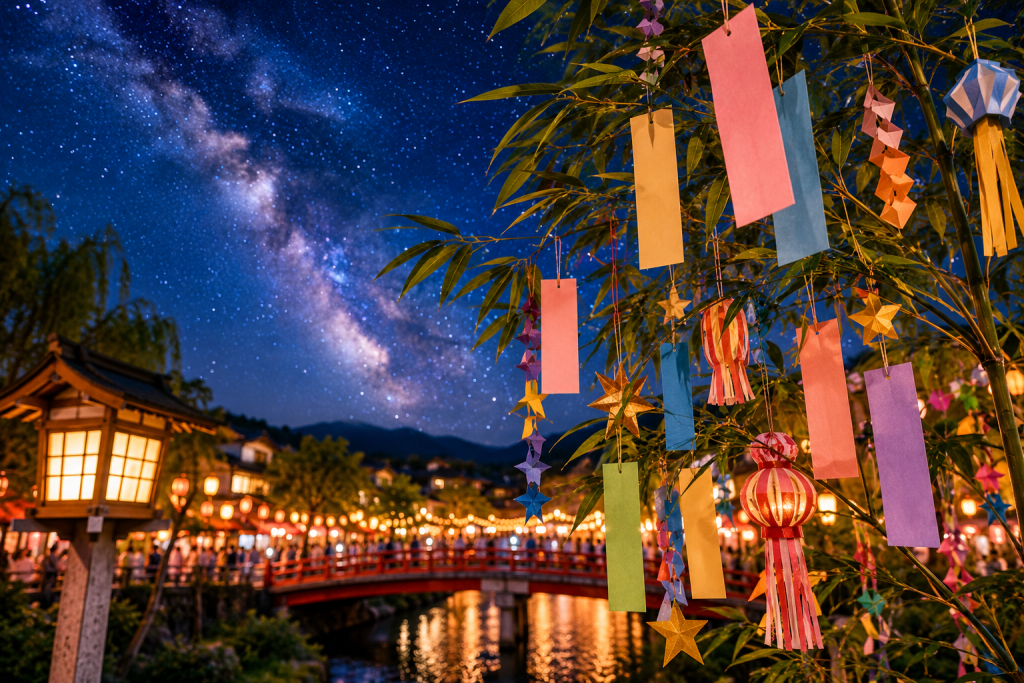
This romantic story is only one part of modern Tanabata. The most familiar custom today is writing wishes on small, colorful strips of paper called tanzaku. These wishes are then hung from bamboo branches.
Children may wish for success at school, a new toy, or the ability to become better at a sport. Adults may write about health, work, love, family, or dreams for the future. The wishes can be serious, humorous, practical, or deeply personal.
Around early July, bamboo decorations appear in schools, shopping streets, train stations, hotels, and public spaces across Japan. The sight of hundreds of colorful paper wishes moving gently in the summer air creates a distinctive atmosphere. Even people who do not think of themselves as religious often enjoy taking part.
This is one reason Tanabata remains meaningful in modern Japan. It does not require a formal ceremony or a particular belief. Anyone can stop for a moment, take a piece of paper, and think about what they truly want.
Large Tanabata festivals are also held in several parts of the country, although some follow the lunar calendar and take place in August. Streets are filled with enormous streamers, paper ornaments, food stalls, and summer crowds. These celebrations transform the quiet act of making a wish into a colorful public festival.
Yet the smallest version of Tanabata may be the most beautiful: a single bamboo branch, a few pieces of paper, and handwritten hopes.
Japan has many seasonal traditions connected to nature—the first cherry blossoms of spring, autumn leaves, the winter moon. Tanabata turns people’s attention toward the summer sky.
In a modern world filled with schedules, screens, and constant information, there is something surprisingly powerful about its simplicity. Once a year, people look upward, remember a story about two distant stars, and write down a wish.
Tanabata reminds us that hope does not need to be grand. Sometimes, it begins with a small piece of paper moving quietly in the summer breeze.