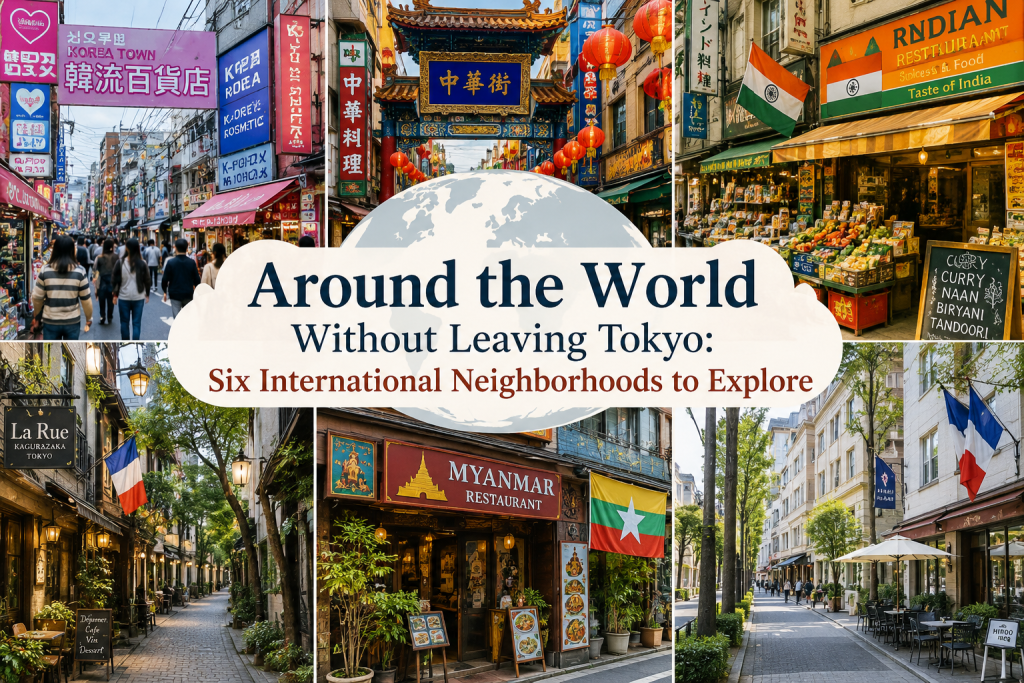
Tokyo is often described as one of the most Japanese cities in the world, yet it is also one of the most international. Beyond temples, sushi bars, and neon streets, the city is home to communities from across Asia, Europe, and beyond. For travelers who want to experience Tokyo from a different angle, exploring its international neighborhoods offers a fascinating journey around the world without leaving the city.
A natural place to begin is Shin-Okubo and Okubo, often known as Tokyo’s Korea Town. Just one stop from Shinjuku, the area is filled with Korean restaurants, beauty shops, K-pop stores, and street food stalls. Visitors can enjoy Korean fried chicken, hotteok pancakes, spicy tteokbokki, and the lively energy of young fans searching for music, cosmetics, and the latest trends.
For a different atmosphere, head to Ikebukuro’s north exit, where Chinese restaurants, supermarkets, and cultural businesses have created one of Tokyo’s most vibrant Chinese communities. Unlike tourist-oriented Chinatowns, this area feels connected to everyday life. Hotpot restaurants, noodle shops, and regional Chinese cuisine make it a rewarding place for food lovers.
In eastern Tokyo, Nishi-Kasai is often associated with the Indian community. Indian restaurants, grocery stores, spice shops, and schools have made the neighborhood an important cultural hub. The smell of curry, cardamom, and freshly baked naan gives the area a warm and welcoming atmosphere. It is one of the best places in Tokyo to experience Indian food beyond the familiar dishes found in standard restaurants.
Another hidden international neighborhood is Takadanobaba, known among many residents for its Myanmar community. Small restaurants serve dishes such as mohinga, tea leaf salad, and rich curries that are still unfamiliar to many visitors. This makes Takadanobaba especially interesting for travelers who want to discover a lesser-known side of Tokyo’s multicultural life.
For a European touch, visit Kagurazaka, a neighborhood with strong French influences. Its narrow stone-paved alleys, stylish cafés, wine bars, and French restaurants give it a refined atmosphere. At the same time, Kagurazaka remains deeply Japanese, with traditional ryotei restaurants and quiet backstreets. This blend of French elegance and Tokyo charm makes it one of the city’s most attractive walking areas.
Finally, Azabu-Juban and Hiroo reveal Tokyo’s cosmopolitan side. With many embassies, international schools, cafés, bakeries, and global restaurants nearby, the area feels comfortable and worldly. Rather than representing one country, it reflects Tokyo’s role as a global city where many cultures quietly coexist.
What makes these neighborhoods special is not only their food or shops, but also the way they show Tokyo’s diversity. Each area tells a story of migration, community, adaptation, and cultural exchange. They remind us that cities are not defined by a single identity, but by the many people who live, work, cook, and gather there.
For visitors, exploring these places offers a deeper understanding of Tokyo. You can eat Korean street food in Shin-Okubo, try regional Chinese cuisine in Ikebukuro, discover Indian spices in Nishi-Kasai, enjoy Myanmar cooking in Takadanobaba, walk through French-inspired Kagurazaka, and finish the day in international Hiroo.
Tokyo may be famous for its Japanese traditions, but its global neighborhoods reveal another equally fascinating side of the city. Sometimes, the best way to understand Japan’s capital is to see how the world has made a home within it.