Among Japan’s many traditional martial arts, Aikido occupies a unique place. Unlike sports that focus primarily on competition or victory, Aikido emphasizes harmony, self-discipline, and the peaceful resolution of conflict. Today, it is practiced in more than 140 countries, with particularly strong communities across Europe, where it has become one of the most respected Japanese martial arts.
Aikido was founded by Morihei Ueshiba (1883–1969), one of the most influential figures in modern Japanese martial arts. Born in present-day Wakayama Prefecture, Ueshiba spent much of his life studying traditional combat techniques while also pursuing a deeper spiritual understanding of human relationships. His vision eventually led to the creation of Aikido, a discipline that sought not simply to defeat an opponent, but to transform conflict into harmony.
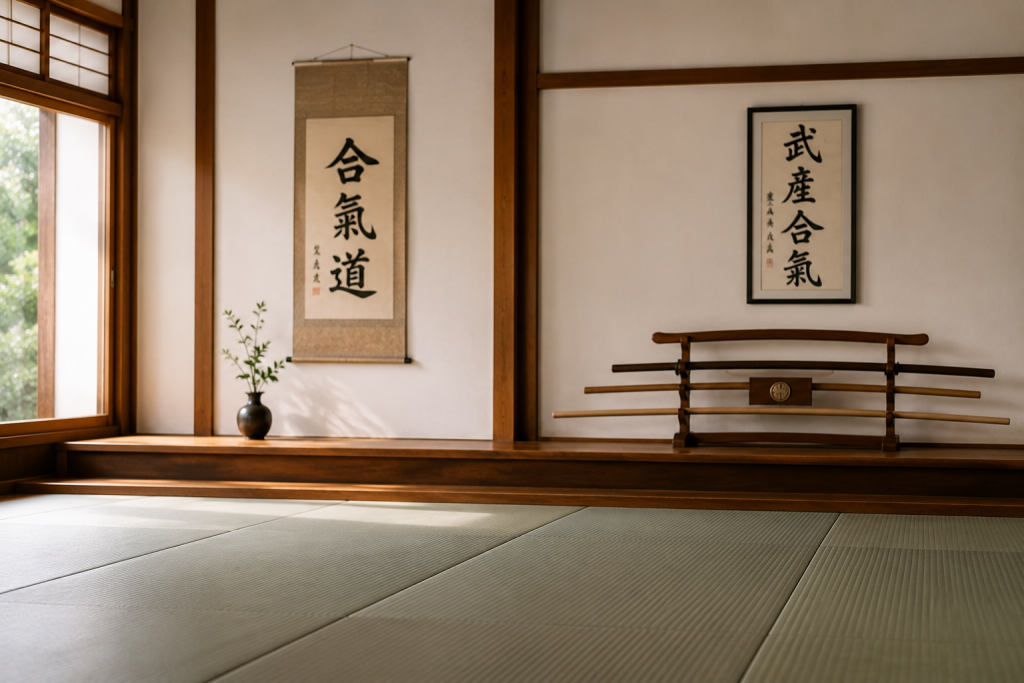
The name itself reflects this philosophy. Ai means harmony or unity, Ki refers to life energy or spirit, and Do means “the Way.” Together, Aikido can be understood as “the Way of Harmonizing Energy.” Like many Japanese traditions—including Sadō (the Way of Tea), Kadō (the Way of Flowers), and Shodō (the Way of Calligraphy)—Aikido is regarded not merely as a technique but as a lifelong path of personal cultivation.
Unlike many combat sports, Aikido does not rely on striking an opponent with punches or kicks. Instead, practitioners learn how to redirect an attack using balance, timing, circular movement, and leverage. Rather than meeting force with greater force, Aikido teaches practitioners to absorb and guide an opponent’s energy, neutralizing aggression while minimizing unnecessary harm.
This philosophy has attracted people far beyond the world of martial arts.
Across Europe, Aikido has developed a particularly strong following. Countries such as France, Germany, Italy, Spain, Belgium, and the United Kingdom have thousands of practitioners and hundreds of dojos. Many Europeans appreciate that Aikido combines physical training with philosophy, discipline, and mutual respect. Since competitions are generally absent, practitioners often describe training as cooperative rather than adversarial, with both partners helping each other improve.
Tokyo remains one of the best places to experience Aikido in Japan. Among its notable dojos is Tendokan, located in Sangenjaya, a neighborhood known for its relaxed atmosphere and local character. Established by one of Morihei Ueshiba’s close uchi-deshi (live-in disciples), Tendokan continues to preserve many of the founder’s teachings while welcoming practitioners from Japan and overseas. Visitors often find that training there offers not only technical instruction but also insight into the etiquette and spirit that define traditional Japanese martial arts.
For many international visitors, Aikido represents something broader than self-defense. It offers a window into Japanese values such as respect, humility, patience, and continuous self-improvement. These ideals resonate with the broader concept of “Do”, the Japanese belief that mastery is not a destination but an ongoing journey.
In an increasingly competitive and fast-moving world, Aikido presents a different vision of strength. True power, it suggests, does not always come from overcoming others. Sometimes it comes from remaining calm, maintaining balance, and transforming confrontation into understanding.
More than a century after Morihei Ueshiba began developing his art, Aikido continues to inspire people around the world. It remains not only a martial art, but also a philosophy of living—one that reminds us that harmony can be stronger than conflict.