Could you know the Haiku?
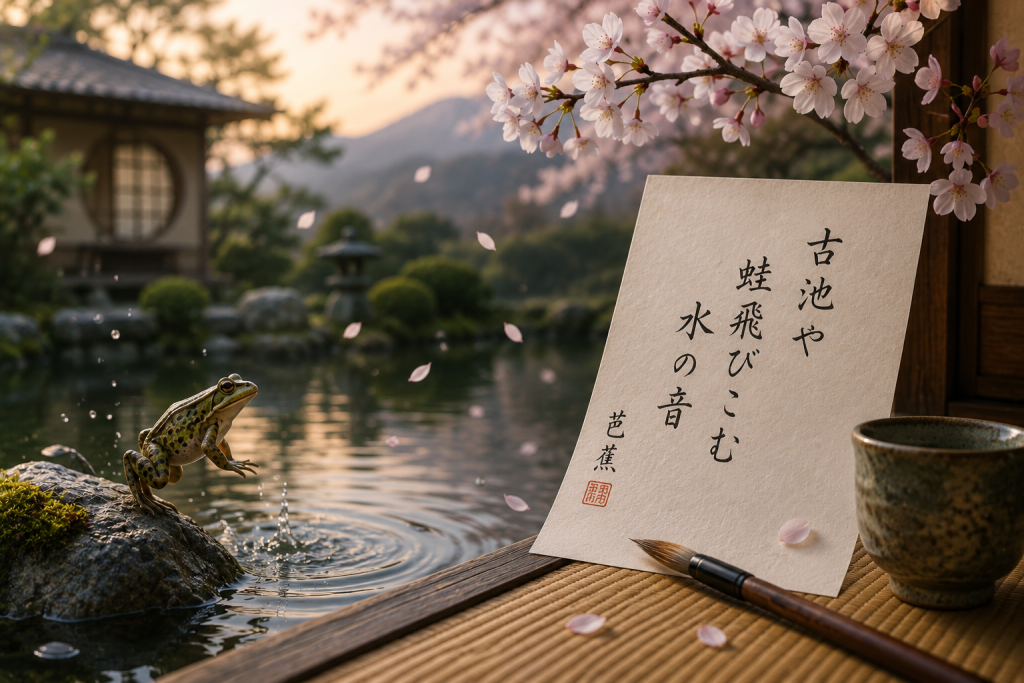
Haiku is one of Japan’s smallest literary forms, yet it has an extraordinary ability to hold attention. A traditional haiku contains just 17 sound units, usually arranged in a 5–7–5 pattern. Within this tiny space, a poet may capture a frog jumping into water, the first chill of autumn, a train disappearing into snow, or a quiet moment at the dinner table.
Why do so many Japanese people continue to be fascinated by such short poems?
Part of the answer lies in the Japanese appreciation of what is left unsaid. A haiku does not explain everything. It presents a moment and allows the reader to complete it.
Consider the famous tradition of writing about cherry blossoms. A haiku does not need to describe the entire meaning of spring. A few petals falling onto an empty bench may be enough. The reader brings memories, emotions, and personal experience into the poem.
This relationship between words and silence is central to haiku. The empty space around the words is almost as important as the words themselves.
Seasonality is another reason haiku feels deeply connected to Japanese life. Traditional haiku usually contains a kigo, or seasonal word. Cherry blossoms suggest spring. Cicadas evoke the intensity of summer. The moon often points toward autumn, while snow can immediately create a winter landscape.
Japan’s changing seasons are already woven into everyday culture through food, festivals, clothing, and conversation. Haiku turns this awareness into a literary practice. It encourages people to notice small changes: the first cold morning, a different sound of rain, or a single red leaf.
Haiku is also unusually accessible. Writing a novel requires enormous time and commitment. A haiku can begin with a moment noticed on a walk. Children write haiku at school, while adults submit poems to newspapers, magazines, local groups, and television programs. Amateur poets can participate without considering themselves professional writers.
This accessibility has helped create a remarkable culture of participation. For many Japanese people, haiku is not simply something written centuries ago by famous poets such as Matsuo Bashō. It is something ordinary people can still create, share, compare, and improve.
There is also a playful side. The strict limitation of the form turns writing into a kind of puzzle. How can a feeling, scene, or surprise be expressed with so few sounds? Which word should remain, and which should disappear? The challenge can become addictive.
Perhaps haiku also fits modern life surprisingly well. In an age of smartphones and endless information, people are accustomed to short forms of expression. Yet haiku is different from a quick social media post. Its brevity is not about speed. It asks for attention.
A good haiku begins with something small: a sound, a shadow, an insect, a cup of tea. But through careful observation, that small moment can open into something much larger.
This may be why Japanese people continue to return to haiku. It transforms the ordinary world without changing it.
It simply asks us to notice.